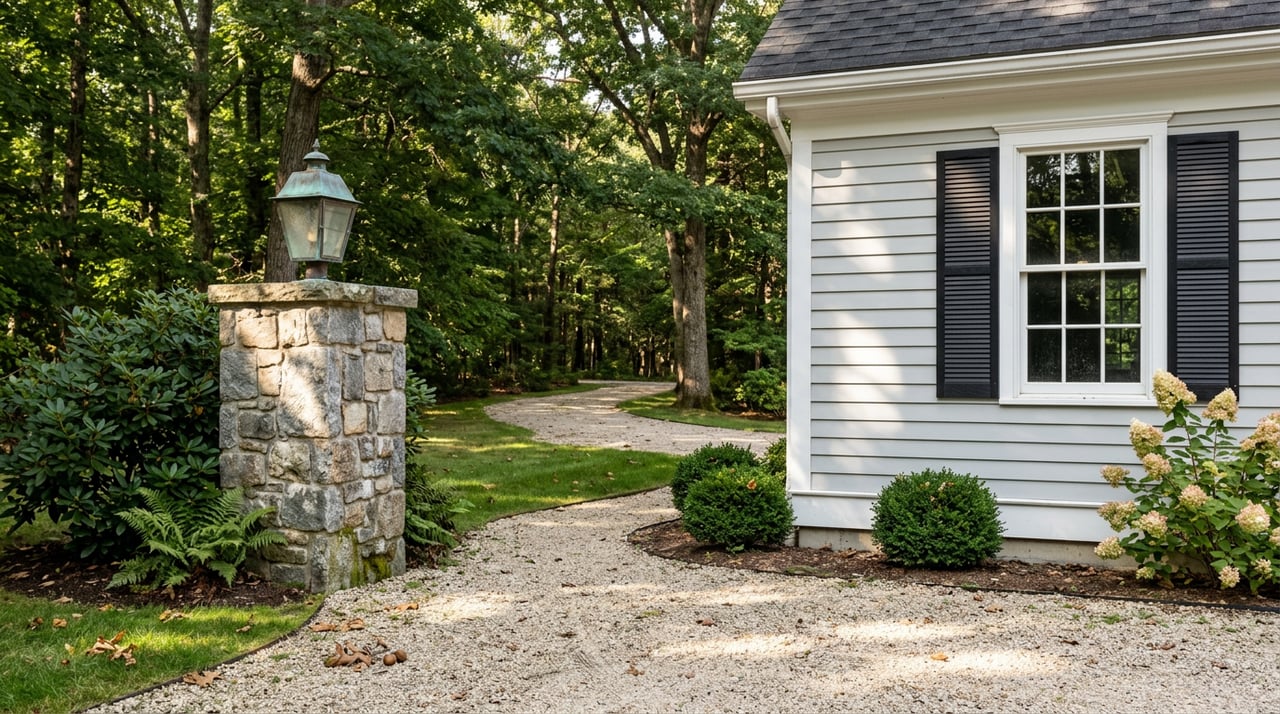
A buyer under contract on a five-acre parcel off North Street called her attorney two weeks before closing with a question she assumed had an obvious answer: who plows the shared gravel road that connects her future driveway to the pavement. The seller had lived there eleven years and never worried about it. The neighbors had always just handled it. There was no invoice, no shared account, no signed agreement anywhere in the file. Just a recorded easement from 1987 granting the right to use the road, and silence about who pays to keep it usable.
That silence is not a paperwork oversight. It is Connecticut's default position, and it puts more financial exposure on a backcountry Greenwich buyer than almost any other line item in the closing binder that nobody reads out loud.
The Statute Fills the Gap, But Not the Way You'd Expect
Most homes on public streets never need to think about this. Backcountry Greenwich is different by design. North of the Merritt Parkway, four-acre zoning under the town's RA-4 and RAC-4 districts spreads houses out far enough that many sit down long private drives or shared rights-of-way rather than town-maintained roads. Conyers Farm, the roughly 1,400-acre private community known for its polo grounds and self-imposed ten-acre minimum lots, is the most visible example, but it is far from the only one.
When a private road serves more than one property and nobody has written down who pays for what, Connecticut law steps in. Connecticut General Statutes Section 47-42f, enacted as Public Act 14-67 in 2014, makes each benefited property owner responsible for the cost of keeping a shared easement or right-of-way in good repair, snow removal included. Where the statute gets interesting is what happens when more than one household shares that road. The law states that costs are split according to a written agreement if one exists, and if it doesn't, according to "the benefit received by each such property."
The statute never defines what proportionate benefit means. It doesn't say whether a household at the far end of a half-mile easement owes more than one near the entrance, whether a property with a longer private spur pays more, or how a newly subdivided lot factors in. If neighbors disagree, the only path forward the law provides is a lawsuit in Superior Court for contribution or specific performance. A 2018 Connecticut Bar Association analysis of the statute put it plainly: the act "alone is inadequate," leaving open questions about governance, voting rights among owners, capital improvements, and even damage caused when older homes are torn down and replaced with larger new construction that brings heavier trucks and more frequent deliveries down the same gravel.
Greenwich Has Already Litigated This, and It Took Years
This is not a hypothetical risk. Greenwich has its own case on the books, and it shows how expensive an undefined easement dispute can get even when the underlying deeds are more than a century old.
In Il Giardino, LLC v. Belle Haven Land Company, a property owner in Greenwich's Field Point neighborhood spent years in litigation over the right to use roads in the adjoining Belle Haven community, based on an easement first recorded in 1901. A trial court sided with the property owner and granted a permanent injunction. The Connecticut Supreme Court reversed that decision in 2000, finding the original deed language didn't support the broader right the owner claimed. The case turned entirely on how a hundred-year-old easement description was worded, and it took a full trial and a state Supreme Court appeal to resolve.
That case was about the right to use a road at all, not the cost of maintaining one, but the lesson carries over directly. When the governing document is vague or missing, resolution doesn't happen at the negotiating table. It happens in a courtroom, on someone else's timeline, at legal fees that dwarf what a signed maintenance agreement would have cost to draft in the first place.
The Market Gives Backcountry Buyers Room to Fix This Before They Own It
Here is where the current market matters, and where most buyers miss their best leverage point.
SmartMLS's full-year 2025 neighborhood figures show a clear split within Greenwich. Old Greenwich and Cos Cob, the town's fastest-moving neighborhoods, both averaged under 40 days on market with sale-to-list ratios above 103 percent, meaning buyers were routinely paying over asking to compete. Back Country and North Parkway sat at the opposite end: 105 to 120 days on market with sale-to-list ratios below 97 percent, meaning buyers in these areas were typically closing below the asking price. Nothing about backcountry's acreage, zoning, or shared-road inventory has changed since, so the same pattern is the one buyers are working against today.
| Old Greenwich / Cos Cob | Back Country / North Parkway | |
|---|---|---|
| Days on market (2025) | Under 40 | 105 to 120 |
| Sale-to-list ratio | Above 103% | Below 97% |
| Typical buyer position | Competing over asking | Negotiating below asking |
That slower clock is usually framed as a downside of backcountry inventory, evidence that these estates take longer to sell because they're harder to finance, harder to compare, or simply less liquid. It's also an opening. A buyer negotiating below asking in a market with 100-plus days on market has real standing to make a signed, recorded private road maintenance agreement a condition of closing, not a loose end to sort out afterward. Sellers in this segment are already accustomed to longer due diligence periods and more negotiating back and forth. Asking for thirty extra days to get four neighbors to sign a cost-sharing document is a reasonable ask in a market that already moves this slowly. It would be a much harder ask in Old Greenwich, where a seller fielding multiple offers over asking has no incentive to slow down for anyone's paperwork.
What to Actually Ask For Before You Close
A private road maintenance agreement doesn't need to be complicated, but it needs to exist in writing and it needs to be recorded on the land records, not just emailed between neighbors. Before removing contingencies on a backcountry Greenwich property that relies on a shared easement, work through this sequence with your attorney:
- Pull the recorded easement or right-of-way language from the town clerk's land records and confirm exactly which properties benefit from it and what the deed actually grants.
- Ask the seller directly whether a written maintenance agreement exists among the benefited owners, and if so, request a copy along with any recent invoices for plowing, grading, or repaving.
- If no agreement exists, treat that as a negotiating point, not a footnote. Push for one to be drafted and signed by all benefited owners before closing, or build seller-funded escrow into the purchase agreement to cover your share of near-term repairs.
- Confirm how the agreement, if one exists, handles capital costs like repaving or drainage work, not just routine snow removal, since those are the expenses most likely to trigger a dispute later.
- If the property sits within a private association like Conyers Farm, ask specifically how road costs are assessed through that association rather than assuming the statute's default rule applies, since many of these communities already have their own governing documents.
None of this replaces the other diligence items that come with backcountry acreage, private wells, septic systems sized to a fixed number of bedrooms, and zoning minimums that can limit what you're allowed to build later. Those matter too. But they're diligence items every backcountry buyer already expects to see on a checklist. The road agreement is the one that gets skipped because it doesn't show up as a line item on a home inspection report, and by the time it becomes a problem, you're the one holding it.
Frequently Asked Questions
What if there's no recorded easement at all, just a driveway everyone has always used? That's a materially different and riskier situation than an easement with no written cost agreement. Have your attorney confirm the legal basis for access before you go further, since an unrecorded arrangement may not survive a change in ownership on the servient property.
Can a maintenance agreement be recorded without every benefited owner agreeing to sign? Generally no. The value of a written agreement under Section 47-42f is that it controls over the statute's default rule, but only if it's enforceable, which means it needs buy-in from the owners it binds. A partial agreement among some but not all benefited owners leaves the same gap for anyone who didn't sign.
Is this only a backcountry issue? Private roads and shared rights-of-way show up anywhere lots were subdivided off a single access point, including older sections of mid-country Greenwich and parts of Stamford and New Canaan. Backcountry simply has the highest concentration of them, given the acreage and the RA-4 and RAC-4 zoning that spreads homes out from public streets.
A house on four acres with a polo field down the road is still, on paper, just a house. What makes it livable is the half-mile of gravel that gets you there, and whether the people who share it with you have ever agreed, in writing, on who pays to keep it that way. If you're weighing a backcountry Greenwich purchase or thinking about what a private road agreement means for your own property before you list, Robin Bartholomew can walk through the specific diligence a shared easement requires in this market. Schedule a consultation before you're the one holding an undefined obligation.